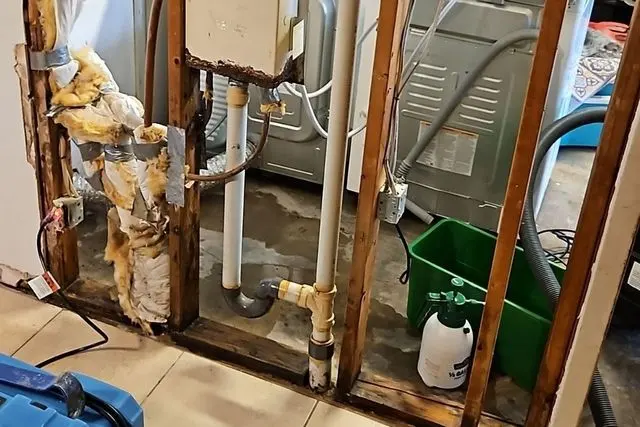
A burst pipe is usually a supply line under full household pressure: a failed fitting behind a vanity, a split line in the laundry wall, a kinked PEX run in the attic. Because it is pressurized, it keeps running until someone closes a valve, and the water follows gravity through walls and down through ceilings into the rooms below.
Where burst pipes show up in Lewisville homes
- Laundry room walls, where hot and cold supply lines and the drain box share a cavity
- Bathroom vanities and toilet supply lines on the second floor
- Attic runs in two-story homes, where a failed line soaks insulation and ceiling drywall
- Exterior walls and hose bibs after a hard freeze
How the cleanup runs
The extraction crew pulls standing water off the floors first. The tech who does the walkthrough then maps the wet footprint on walls and ceilings with a thermal camera and pinless meters, because burst pipe water rarely stays in the room where it started.
- Baseboards come off and drywall is cut just above the wet line where readings require it.
- Wet insulation in walls and attics is removed; it does not dry in place.
- Air movers, LGR dehumidifiers and wall cavity drying systems run until the framing reads dry.
Know your valves. Most Lewisville homes have the main shutoff near the street in a meter box or on a line entering the garage. Finding it before an emergency saves a lot of drywall.
Clean water does not stay clean
Water from a supply line starts as Category 1. After it sits in carpet, runs through wall cavities and picks up dust and building materials, it can shift to Category 2 within a couple of days, which changes what can be saved. That is the practical reason to start extraction right away. The EPA mold page explains why the 24 to 48 hour window matters, and the Texas Department of Insurance has consumer help on filing a property claim.