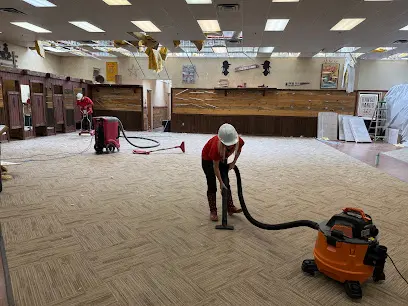
Lewisville's commercial base runs along I-35E, around Vista Ridge Mall and the FM 3040 retail corridor, and through the office and warehouse parks near SH-121. Flat roofs, interior roof drains, fire sprinkler lines and restroom supply lines are the usual sources. A failed line overnight can reach several suites before the building opens in the morning.
What commercial losses usually involve
- Carpet tile and commercial carpet glued to slab
- Suspended ceiling tiles and the insulation above them
- Demising walls shared between tenants
- Stock, records and equipment that need to move out of the drying area
How the job is planned
The tech who does the walkthrough maps the wet area by zone and flags what can stay in use. The commercial drying team then sets containment, extraction and drying equipment zone by zone, so a store, office or warehouse can keep part of its space running where it is safe.
- Extraction first, with truck-mounted units where hoses can reach.
- Wet ceiling tiles and insulation come down; walls are read and opened only where needed.
- Air movers and large LGR or desiccant units dry the space, sized to its volume.
- Daily readings and photos are shared with the owner, the manager and the adjuster.
Managing a property? Keep the shutoff locations for the building main and the fire riser on file, and know who is authorized to approve emergency work after hours.
Downtime and documentation
For a business, the drying plan and the paperwork matter as much as the equipment. A clear scope, daily logs and photos support both the property claim and any business interruption claim. The Ready.gov business page covers continuity planning, and the OSHA flood page covers worker safety around contaminated water. Coverage depends on your policy, so it is worth checking with your own insurer.