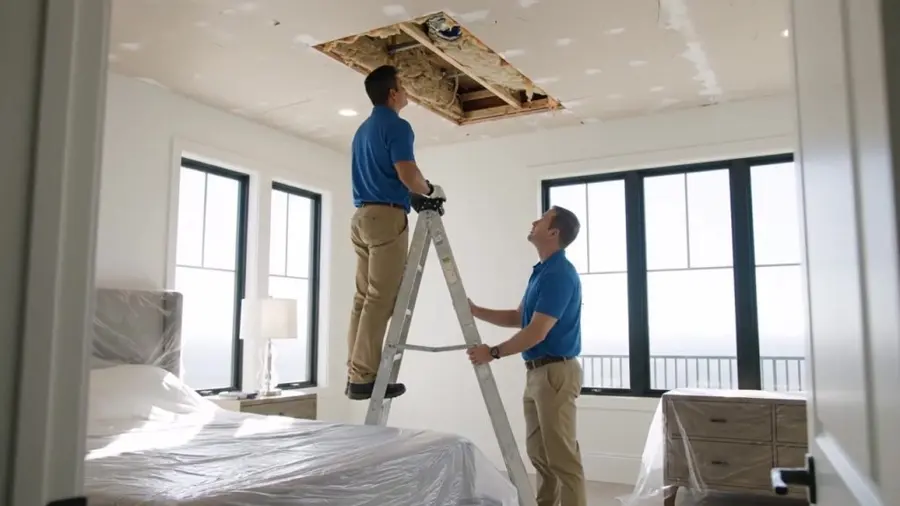
Ceiling leaks in Lewisville usually start with something upstairs: a toilet supply line, a shower pan, a tub drain, an upstairs laundry, or an attic air handler. The water runs along joists and pools on the back of the drywall until it finds a seam, a nail or a light fixture. By the time a drip shows, the wet area above is almost always bigger than the stain.
Ceiling leak or roof leak?
- A leak under a bathroom or laundry that shows up in dry weather points to plumbing
- A stain that grows after rain points to the roof; see hail and roof leak damage
- A ring near an air return or in the middle of a summer points to the AC drain; see AC drain line leaks
How the ceiling is handled
The tech who does the walkthrough scans the ceiling with a thermal camera and reads it with pinless meters to find the full wet footprint. A sagging, water-filled ceiling is relieved in a controlled way so it does not come down on furniture or people.
- Saturated sections are cut out, sized to the readings rather than the stain.
- Wet insulation above the ceiling comes out.
- Air movers push air into the ceiling cavity, and dehumidifiers pull moisture from the room.
- Walls and floors below the leak get mapped too, since ceiling water keeps running down.
Sagging ceiling? Keep people out from under it, switch off the lights and fans in that room at the breaker, and put a bucket under the lowest point.
Ceiling stains after the water is gone
Paint over a wet ceiling and the stain comes back. The ceiling has to read dry first, and a stain-blocking primer goes on before the finish coat during repairs. The EPA moisture and mold page explains why wet building materials need to dry within 24 to 48 hours, and EPA WaterSense lists common household leak sources.